Income Protection Insurance Exclusions in NZ: What’s Not Covered?
Understanding income protection insurance exclusions is just as important as knowing how much cover you could receive. While income protection helps replace lost earnings when illness or injury prevents you from working, not every situation qualifies for payment. In New Zealand, exclusions and policy limitations can differ considerably, making it worthwhile to compare the actual financial protection offered rather than choosing a policy based on premiums alone.
Key Takeaways
- Income protection generally covers qualifying illness or injury, subject to exclusions, disability definitions and other claim requirements.
- General exclusions form part of the standard policy wording, while individual exclusions may be applied following medical or occupational underwriting.
- Mental health conditions, pregnancy-related incapacity, previous injuries and high-risk activities may be subject to different restrictions.
- The Financial Markets Authority’s insurance advice guidance highlights the importance of understanding policy terms and limitations before purchasing or replacing cover.
- Private income protection and ACC serve different purposes. ACC guidance on what it covers explains that general illness is typically outside the accident compensation scheme.
- The Contracts of Insurance Act 2024 reforms take effect on 15 November 2027 but will not automatically remove existing medical exclusions.
- Comparing exclusions, premiums and benefits together can help you identify suitable financial protection.
Before committing to a policy, compare now to explore income protection options that reflect your financial needs and personal circumstances.
What Are Income Protection Insurance Exclusions?
An exclusion is a contractual provision that removes specified conditions, activities or circumstances from insurance coverage. If your incapacity falls within an applicable exclusion, your claim may be declined even when you are medically unable to work.
Exclusions help insurers define the risks they are prepared to cover. However, their scope can vary between insurance contracts.
General Exclusions vs Individual Exclusions
There are two main types of exclusions to understand when purchasing income protection.
| General exclusions | Individual exclusions |
| Included in standard policy wording | Added to your individual insurance terms |
| Apply according to the insurance contract | Apply to specified personal risks |
| Determined by product design | Often determined through underwriting |
| May include war or intentional self-inflicted injuries | May include previous back injuries or particular medical conditions |
| Generally not individually reviewable | May be eligible for reassessment |
Both your standard policy wording and individual policy schedule should be reviewed before accepting cover.
What Does Income Protection Insurance Not Cover in New Zealand?
Common income protection insurance exclusions can involve medical conditions, personal activities and specific causes of incapacity. However, the following restrictions are not universal across all New Zealand policies.
Pre-Existing Medical Conditions
Previous illnesses, injuries and ongoing medical conditions may result in individual exclusions. A history of back problems, for example, could lead to restrictions on claims involving particular spinal conditions.
Having a medical history does not automatically mean a condition will be excluded.
Intentional Self-Inflicted Injuries
Many policies contain exclusions relating to intentionally self-inflicted injuries. The circumstances surrounding a claim and the specific contractual wording determine how these provisions apply.
Criminal Activities and Unlawful Behaviour
Some policies exclude incapacity resulting from participation in unlawful activities. Check how the contract defines unlawful behaviour and the connection required between that behaviour and the claimed incapacity.
Alcohol and Drug-Related Conditions
Certain policies contain restrictions involving alcohol consumption or drug use. These provisions may distinguish between prescribed medication, unlawful drug use and particular circumstances involving alcohol.
Not every alcohol-related illness is automatically excluded.
Pregnancy and Childbirth
Normal pregnancy, childbirth and parental leave generally do not, by themselves, qualify for standard income protection payments.
However, pregnancy-related complications causing prolonged incapacity may be covered under certain contracts. Waiting periods and other policy conditions can apply, so check the wording carefully if you are planning a family.
War and Civil Unrest
Insurance contracts may exclude injuries or illnesses connected with war, civil unrest or participation in specified violent events.
The scope of these restrictions can differ, including how they apply while travelling overseas.
High-Risk Sports and Recreational Activities
Activities such as motorsport, mountaineering and recreational aviation may influence underwriting decisions.
Depending on the activity and frequency of participation, an insurer may offer standard terms, charge an additional premium, apply an exclusion or decline cover.
Redundancy and Voluntary Unemployment
Standard income protection generally responds to incapacity caused by illness or injury, rather than ordinary job loss, resignation or retirement.
Redundancy protection, where available, is a separate or additional benefit with its own eligibility requirements.
Mental Health Conditions
Mental health coverage varies between policies. Some contracts cover qualifying mental health conditions, while others contain individual exclusions, broader restrictions or limits on benefit duration.
Check whether conditions such as depression, anxiety and stress-related disorders are covered and whether any special payment limits apply.
How Pre-Existing Conditions Affect Income Protection Cover
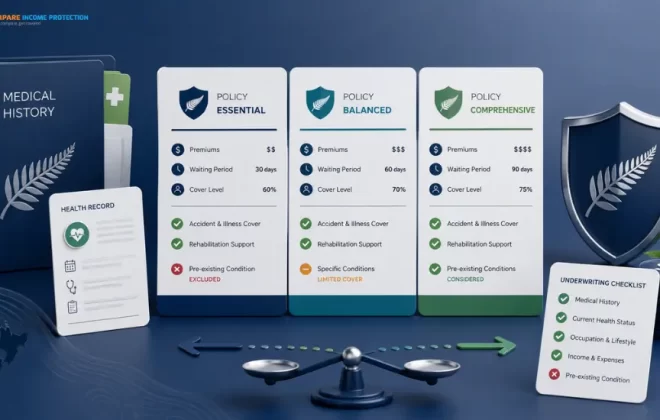
When applying for income protection, your medical history may influence the terms offered. Underwriting considers factors such as previous treatment, current symptoms, recovery and occupational duties.
Possible outcomes include standard acceptance, medical exclusions, premium loadings, or a decision to defer or decline the application.
Medical Exclusions vs Premium Loadings
| Medical exclusion | Premium loading |
| Restricts specified coverage | Increases the cost of insurance |
| May prevent certain claims | Does not itself exclude a condition |
| Creates a potential coverage gap | Creates an additional financial cost |
| May be reviewable | May be reviewable |
This distinction matters when comparing insurance offers. Where an insurer offers a premium loading instead of a particular exclusion, the offer may provide broader cover for that risk, although all other policy terms still apply.
Our guide to income protection with pre-existing conditions in New Zealand explains how medical history can affect available cover.
If you have a previous illness or injury, compare now to explore different options rather than assuming every policy will have identical medical restrictions.
Income Protection Exclusions vs Policy Limitations
Not every restriction is an exclusion. Understanding the difference between income protection insurance exclusions and other policy limitations can help prevent unexpected financial gaps.
| Policy restriction | How it affects your cover |
| Exclusion | Removes specified risks from coverage |
| Waiting period | Determines how long qualifying incapacity must continue before benefits become payable |
| Benefit period | Limits how long eligible payments can continue |
| Disability definition | Determines whether your incapacity qualifies for payment |
| Income replacement limit | Restricts the maximum benefit available |
| ACC offset | May reduce private insurance payments |
| Mental health benefit limit | May restrict the duration or amount of eligible payments |
For example, if you select an eight-week waiting period but recover after six weeks, the monthly benefit may not become payable. Your condition has not necessarily been excluded; you simply have not satisfied the waiting-period requirement.
Similarly, a two-year benefit period may end while you are still unable to work.
How to Read and Understand Income Protection Exclusion Wording
The precise wording of income protection insurance exclusions can significantly influence whether a future claim qualifies.
Narrow vs Broad Medical Exclusions
Consider these hypothetical examples.
| Illustrative exclusion wording | Potential implications |
| Claims arising from a previous lumbar disc injury | May focus on a particular previous injury |
| Claims arising from disorders of the lumbar spine | May extend to multiple lower-back conditions |
| Claims arising directly or indirectly from spinal disorders | Could have a broader application |
| Injuries arising from participation in specified motorsport activities | May exclude claims connected to those activities |
These are illustrative examples rather than actual insurance contract terms.
What Does Directly or Indirectly Caused Mean?
An exclusion referring to indirect causes may extend beyond the original diagnosis or injury. Its application depends on the contractual wording, medical evidence and circumstances of the claim.
Ask for clarification if you cannot determine whether related conditions would also be excluded.
Where Can You Find Policy Exclusions?
Review the following documents:
- Standard policy wording.
- Individual policy schedule.
- Special underwriting terms.
- Policy endorsements and amendments.
- Accepted insurance offer documents.
Two policies with similar premiums may provide substantially different protection. Before committing to cover, compare now to consider the actual terms alongside the monthly cost.
Can You Still Claim Income Protection if Your Policy Has an Exclusion?
Yes. An exclusion relating to one condition does not necessarily prevent claims for unrelated illnesses or injuries.
The following hypothetical scenarios illustrate how exclusions and other contractual requirements could affect claims.
| Claim scenario | Potential outcome |
| A person with a lower-back exclusion develops an unrelated cancer | May qualify for benefits |
| Incapacity results directly from an excluded previous injury | Claim may be declined |
| An excluded condition contributes to another medical problem | Depends on medical evidence and policy wording |
| A covered illness prevents work for less than the waiting period | Regular monthly payments may not become payable |
Where multiple medical conditions contribute to incapacity, determining the cause of disability can become more complicated.
If a claim is declined, request written reasons and review the relevant contractual provisions. Additional medical evidence or independent professional advice may help you understand the decision and your options.
Read our guide explaining why income protection claims are denied in New Zealand for further information about claim eligibility.
Can Income Protection Exclusions Be Removed?
Some individual medical exclusions may be eligible for reassessment, particularly where health circumstances have improved.
An insurer may consider updated specialist reports, completed treatment, recovery progress and the length of time without recurring symptoms.
However, not every exclusion is reviewable, and improved health does not guarantee its removal.
Switching insurance policies may result in different underwriting terms, but it could also introduce new exclusions. Avoid cancelling existing cover until suitable replacement insurance has been confirmed and is in force.
Does ACC Cover Conditions Excluded From Private Income Protection?
ACC and private income protection operate differently. An exclusion under private insurance does not automatically determine whether ACC will cover the same injury.
| Situation | ACC | Private income protection |
| Qualifying accidental injury | May provide cover | Subject to policy terms |
| General illness | Generally not covered | May provide cover |
| Pre-existing medical condition | Depends on statutory eligibility | Depends on underwriting and policy terms |
| Mental health condition | Limited to qualifying circumstances | Coverage varies |
| Ordinary redundancy | Not covered | Generally outside standard cover |
ACC compensation may also reduce private income protection payments where the insurance contract contains applicable offset provisions.
How the 2027 Insurance Law Changes Affect Income Protection Exclusions
New Zealand’s Contracts of Insurance Act 2024 comes into force on 15 November 2027, introducing changes to insurance disclosure duties and remedies for qualifying disclosure breaches.
Under the applicable new consumer disclosure framework, applicants must take reasonable care not to make a misrepresentation when answering insurance questions.
However, the reforms will not automatically remove existing exclusions, guarantee acceptance or make previously excluded conditions eligible for claims.
Insurers will continue assessing medical histories and may continue applying contractual exclusions or other underwriting terms. Existing disclosure obligations remain relevant before the new legislation commences.
How to Compare Income Protection Insurance Exclusions Before Buying
Choosing suitable income protection involves more than comparing monthly premiums. It is equally important to consider how different policies could respond when you cannot work.
| What to compare | Why it matters |
| General exclusions | Identifies standard coverage restrictions |
| Individual medical exclusions | Highlights personal coverage gaps |
| Exclusion wording | Determines the scope of restrictions |
| Mental health coverage | Identifies exclusions and benefit limits |
| Occupational restrictions | Helps assess work-related coverage |
| Reviewable exclusions | Provides potential future flexibility |
| Disability definitions | Influences claim eligibility |
| Waiting and benefit periods | Determines payment timing and duration |
| Premiums and loadings | Affects affordability |
Why the Cheapest Policy May Not Offer the Best Protection
A lower premium can reflect differences in benefit periods, restrictions or the scope of cover, so price alone does not show how comprehensive a policy is.
Consider your occupation, medical history, household expenses, mortgage commitments and available savings before deciding which features matter most.
If you want to balance affordability with meaningful financial protection, compare now to explore options based on more than price alone.
Income Protection Exclusions Checklist
Before purchasing or replacing income protection, work through the following checklist:
- Read the standard policy exclusions.
- Check individual medical restrictions.
- Understand whether related conditions are excluded.
- Confirm mental health coverage and benefit limits.
- Check pregnancy-related restrictions.
- Review occupational and recreational activity exclusions.
- Ask whether individual exclusions can be reviewed.
- Understand disability definitions and waiting periods.
- Check ACC offsets and income replacement limits.
- Compare premiums against the actual coverage offered.
- Confirm replacement cover before cancelling existing insurance.
Ask for written clarification about any terms you find difficult to understand.
Final Thoughts: Choose Income Protection That Works for You
Knowing what your insurance does not cover is an important part of protecting your financial future. The most suitable policy should reflect your health, occupation, lifestyle and financial responsibilities.
At Compare Income Protection NZ, we believe making an informed decision starts with understanding your options. Whether you are purchasing cover or reviewing an existing policy, compare now to explore financial protection that suits your circumstances.
Frequently Asked Questions
Q: What Are the Most Common Income Protection Insurance Exclusions in NZ?
A: Common examples include intentional self-inflicted injuries, certain pregnancy-related circumstances, unlawful activities and war-related events. Individual medical exclusions may also apply, depending on underwriting.
Q: Does Income Protection Cover Pre-Existing Medical Conditions?
A: It may. Insurers assess medical histories individually and may offer standard cover, apply exclusions, charge additional premiums or impose other underwriting terms.
Q: Does Income Protection Cover Mental Health Conditions?
A: Some policies cover qualifying mental health conditions. Others contain specific exclusions or benefit limitations. Always check your individual policy terms.
Q: Does Income Protection Cover Pregnancy and Childbirth?
A: Pregnancy or childbirth alone generally does not qualify for income protection payments. Certain complications causing prolonged incapacity may be covered, depending on the contract.
Q: Can I Claim Income Protection if I Am Made Redundant?
A: Standard income protection generally does not cover redundancy. Separate or additional redundancy benefits may be available under certain insurance arrangements.
Q: Can Medical Exclusions Be Removed From Income Protection?
A: Some individual exclusions may be reviewed following recovery or changes in medical circumstances. Removal depends on the insurer’s reassessment and is not guaranteed.
Q: Can I Claim for an Illness Unrelated to My Medical Exclusion?
A: Yes, potentially. An individual exclusion does not necessarily affect unrelated conditions, provided all other claim requirements are satisfied.
Q: Do All Income Protection Policies Have the Same Exclusions?
A: No. General exclusions, individual underwriting terms and coverage limitations can differ considerably between insurance contracts.
Q: Will ACC Cover an Injury Excluded From My Income Protection Policy?
A: Potentially. ACC assesses eligibility under its own statutory requirements, independently of exclusions contained in private insurance contracts.
Q: Will the 2027 Insurance Law Changes Remove Existing Exclusions?
A: No, not automatically. The reforms introduce changes to disclosure obligations and other contractual protections, but existing medical exclusions are not removed simply because the new law takes effect.